
Buying guide
Best drip irrigation systems for large gardens: 7 kits for bigger layouts
DIG GE200 is the best documented starting point for a large mixed garden, with up to 700 square feet of stated coverage and expansion beyond 1,000 square feet. G77AS is easier to consider when plantings are irregular and exact coverage is less important than flexible emitters.
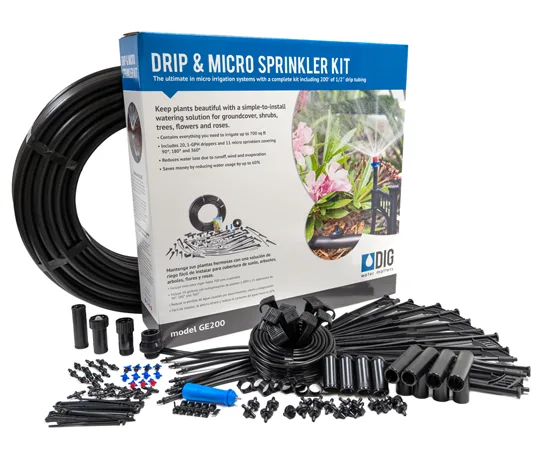
Large gardens need more than a longer roll of tubing. The water source, zone plan, plant spacing, and route between beds all affect the result. DIG GE200 leads this group because its record lists up to 700 square feet, expansion beyond 1,000 square feet, 200 feet of 1/2-inch tubing, 50 feet of microtube, 20 emitters, and 11 micro-sprayers.
G77AS is the better fit when the garden has trees, shrubs, flowers, and uneven beds. Orbit 58911 belongs in this guide only when part of the property is lawn and needs a separate automatic sprinkler layout. GF100 is the source-specific choice for a large garden supplied by an elevated rain barrel.
She Gardens used locked manufacturer pages and the independent comparison in the research record. She Gardens did not test these kits. The stated square-foot figures are product claims. Measure your source, split the garden into sensible zones, and check current availability before ordering.
Large-garden irrigation comparison
| Product | Best fit | Useful evidence | Main drawback |
|---|---|---|---|
| DIG GE200 Drip and Micro Sprinkler Kit | Large mixed garden | Up to 700 sq ft; expansion beyond 1,000 sq ft | More parts to plan |
| DIG G77AS Landscape Drip Watering Kit | Irregular landscape beds | Point emitters; filter and pressure regulation | Coverage is not stated |
| DIG GF100 Gravity Feed Drip Kit | Large rain-barrel layout | 100 ft drip tubing; 50 drippers | Needs elevated reservoir |
| DIG ST100AS Drip Soak Tape Vegetable Watering Kit | Long vegetable rows | 100 ft tape; five rows; 12-inch spacing | Row-only layout |
| DIG ML50 Raised Bed Drip Irrigation Kit | One section of a large garden | Five 10 ft lines; expansion path | Small starting area |
| Orbit Complete Yard Watering Kit | Large lawn section | Four-station automatic system | Coverage depends on supply |
| Orbit All-In-One Sprinkler Kit | One lawn zone beside beds | About 1,250 sq ft; six heads | Needs 50 PSI and 5 GPM |
Best documented large-garden kit: DIG GE200
GE200 is the strongest starting point when a large garden contains several watering patterns. DIG lists up to 700 square feet and expansion beyond 1,000 square feet on the manufacturer page. The kit includes 200 feet of 1/2-inch tubing, 50 feet of 1/4-inch microtube, 11 micro-sprayers, 20 1-GPH emitters, and a 25 PSI regulator with a backflow preventer.
The adjustable 360, 180, and 90 degree sprayers help when beds are not all the same shape. They also make the system more involved than a simple dripline. Use a drawing before laying tubing, then keep each zone’s job clear.
Pros: Largest documented drip capacity here; long supply tubing; 20 emitters; 11 sprayers; expansion beyond 1,000 square feet.
Cons: More components to place; spray can wet foliage; actual coverage depends on source and layout.
Check the current DIG GE200 listing
Best for irregular beds: DIG G77AS
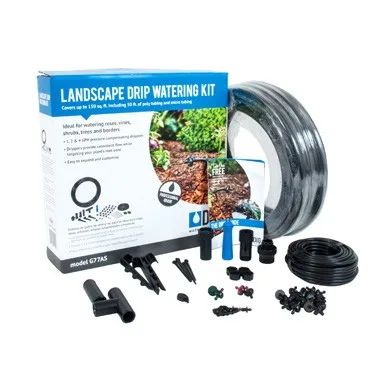
G77AS is the flexible landscape choice. Its DIG listing describes a faucet connection, filter, pressure regulation, distribution tubing, and point-source emitters. It is suited to shrubs, trees, flower beds, and mixed landscape plantings.
The source does not state exact coverage. That is the main reason it sits behind GE200 for a large garden. Use G77AS when you can draw the route and choose emitter positions yourself. Do not use an unstated coverage number to size a property.
Pros: Point-source emitters; filter and pressure regulation; suited to mixed plantings; flexible layout.
Cons: Coverage is not stated; exact warranty and stock are not stated; more measuring is required.
Check the current DIG G77AS listing
Other ways to cover a large garden
DIG GF100 for an elevated rain barrel
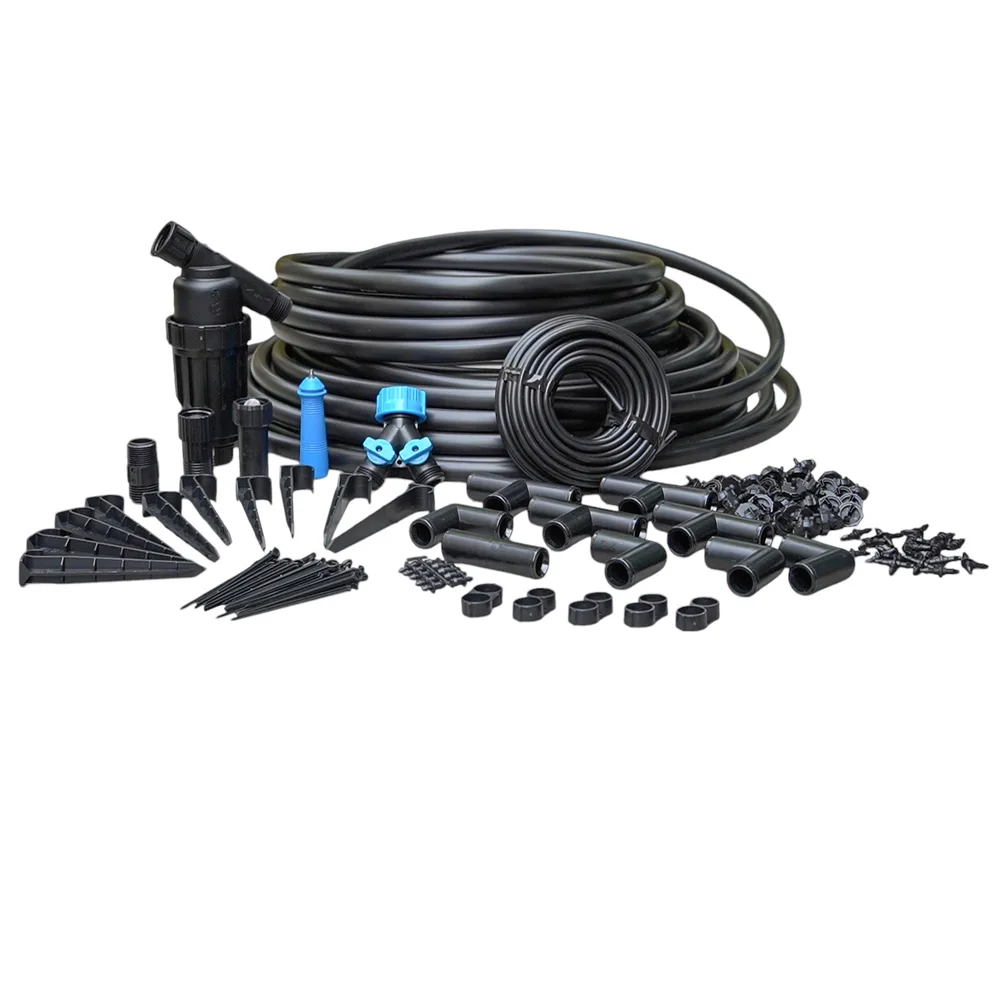
GF100 is the source-matched pick when a large garden uses an elevated rain barrel. DIG lists 100 feet of 1/2-inch drip tubing, 50 feet of 1/4-inch microtube, 50 button drippers, and a 155-mesh filter on its product page.
It does not turn a low-pressure reservoir into a faucet. Reservoir elevation controls whether the layout works, and the record does not include a documented automatic controller. Keep those limits visible when you plan a large area.
Pros: Designed for an elevated rain barrel; 100-foot main line; 50 drippers; filter included.
Cons: Needs reservoir elevation; no documented automatic controller; low-pressure coverage must be checked.
Check the current DIG GF100 listing
DIG ST100AS for vegetable rows
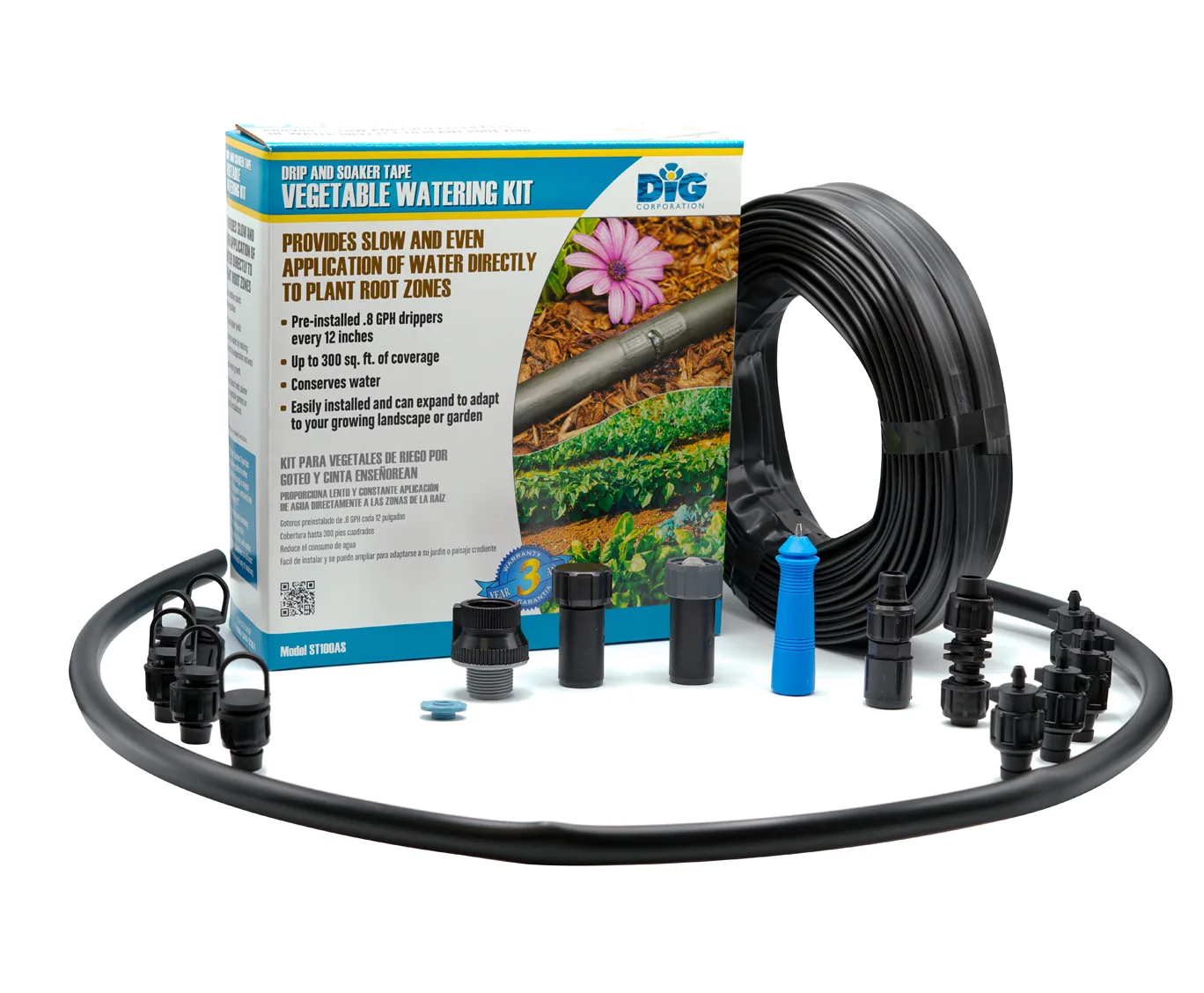
ST100AS adds useful length when the large garden is organized into straight rows. DIG lists 100 feet of drip tape, 0.5 GPH emitters every 12 inches at 25 PSI, five rows, flow control, and five connectors on the manufacturer page.
It is a poor match for trees and scattered ornamentals. The tape is best kept in repeated rows where its spacing makes sense.
Pros: 100-foot tape; five rows; documented emitter spacing and flow; flow control included.
Cons: Limited to row-style layouts; not a flexible tree or shrub solution; needs a faucet-fed setup.
Check the current DIG ST100AS listing
DIG ML50 for one garden section
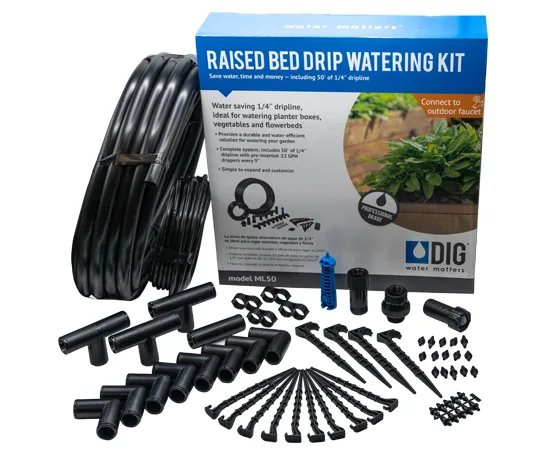
ML50 is not a whole-large-garden answer by itself, but it can be the right module for a defined section. DIG lists five 10-foot lines, 9-inch emitters, up to 150 square feet, and expansion beyond 700 square feet on the model page. A 25 PSI regulator, filter, backflow preventer, and 1/2-inch supply tubing are included.
Use ML50 when a raised bed has a clear boundary. Use GE200 when several beds and landscape areas need one larger starting kit.
Pros: Clear short-line layout; documented 150-square-foot starting area; pressure parts included; expansion path.
Cons: Too small as a stand-alone large-garden system; needs multiple planning decisions when repeated; bed-focused.
Check the current DIG ML50 listing
Orbit 58911 for a lawn section
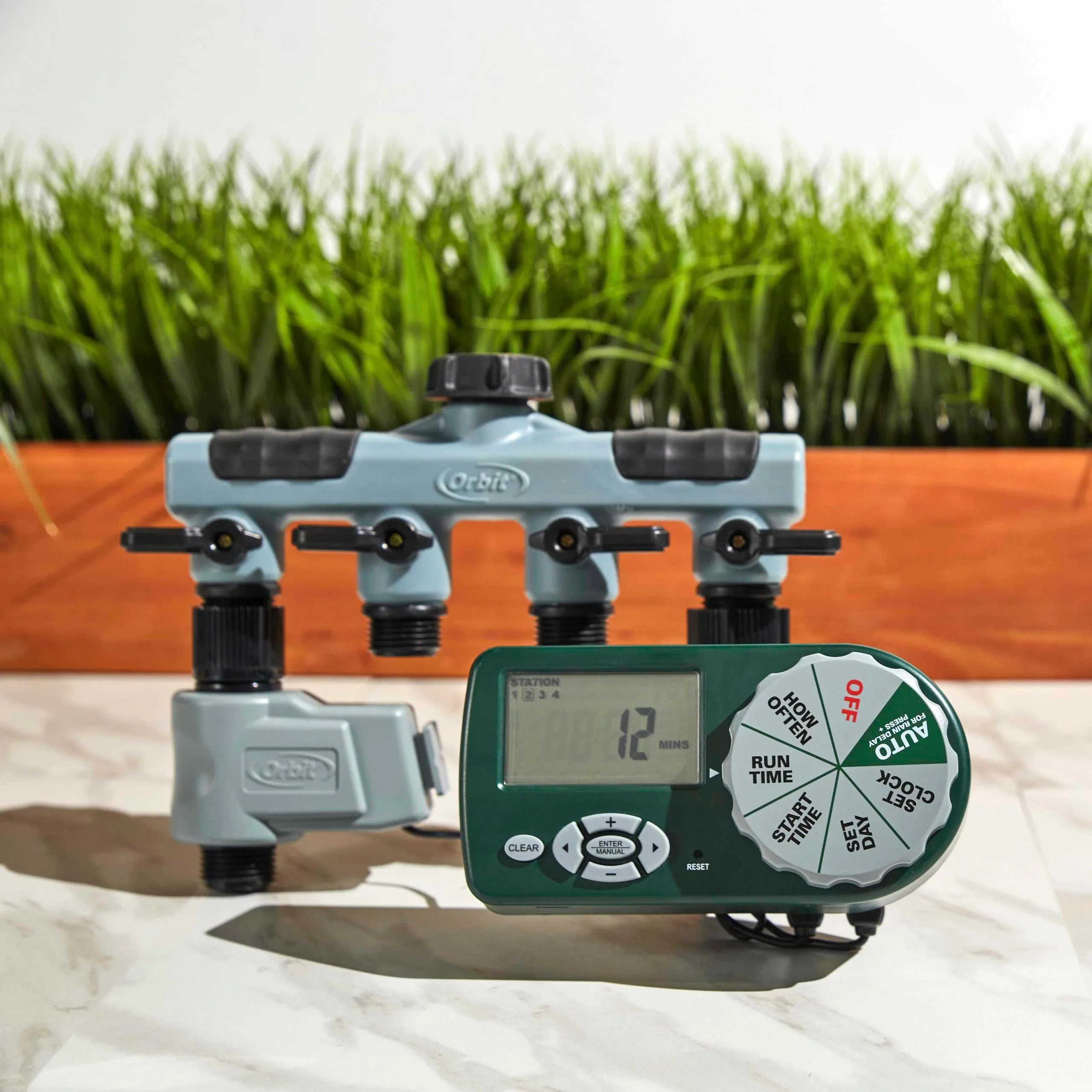
Orbit 58911 belongs beside drip kits when the property includes a lawn that needs its own sprinkler stations. Orbit describes it as a four-station hose-faucet sprinkler system on the product page. Exact coverage depends on water pressure and layout.
Keep lawn sprinklers separate from drip zones. The lawn has different placement and flow needs, and combining both jobs into one unplanned route makes troubleshooting harder.
Pros: Four automatic stations; lawn-focused; hose-faucet connection; useful for a larger yard section.
Cons: Exact coverage is not stated; more components to configure; not a drip system for planting beds.
Check the current Orbit 58911 listing
Orbit 50020 for one lawn zone
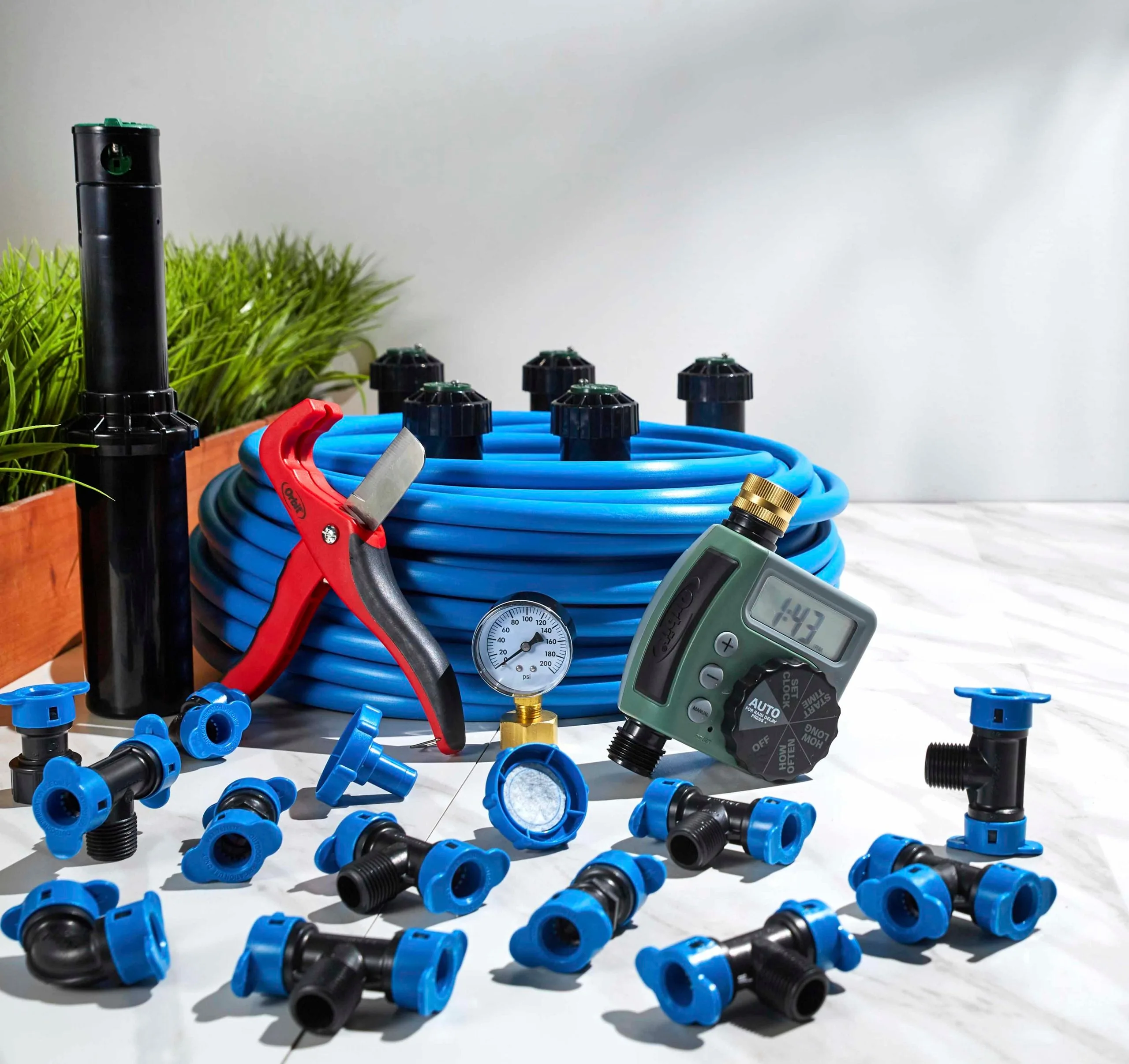
50020 is the smaller lawn companion in this list. Its manufacturer record lists six gear-drive sprinklers, a digital timer, about 1,250 square feet depending on flow, a 15- to 25-foot radius, and a 40- to 360-degree adjustment range. It requires at least 50 PSI and 5 GPM.
Choose it only for a lawn zone that meets those source requirements. It does not add drip emitters for garden beds.
Pros: Automatic timer; six heads; documented radius and adjustment; one-zone layout.
Cons: Needs 50 PSI and 5 GPM; coverage varies; lawn-only use.
Check the current Orbit 50020 listing
Buying criteria for a large garden
Draw zones by plant type and water source. Keep straight vegetable rows together, group containers separately, and give trees and shrubs a route that can be inspected. Long tubing does not remove the need for pressure regulation or filters.
Measure the distance from the faucet or reservoir to the farthest planting. Count turns and branches. The 200 feet of GE200 supply tubing is useful, but the actual route may consume it quickly when beds are spread out.
Split the job before installing. One large loop is harder to diagnose than several defined areas. If the source cannot support the whole plan at once, use separate stations or select a source-matched kit. Do not treat a square-foot claim as a promise for every pressure condition.
For the hose from a faucet to the garden, the large-garden hose guide covers reach and handling. If the property also includes lawn, the lawn irrigation guide covers sprinkler systems separately.
Frequently asked questions
What is the best irrigation kit for a large garden?
DIG GE200 has the clearest large-area record here, with up to 700 square feet stated and expansion beyond 1,000 square feet. G77AS is a better fit when irregular plantings need point emitters and you are willing to measure coverage yourself.
How do I irrigate a large garden from a rain barrel?
DIG GF100 is designed for an elevated rain barrel and includes 100 feet of drip tubing, 50 drippers, and a filter. Reservoir elevation affects the result, and the record does not document automatic scheduling.
Should a large garden use one irrigation zone?
Usually, divide the garden by layout and plant needs. Separate rows, trees, shrubs, and lawn sections are easier to plan and inspect than one mixed route. Source pressure and flow determine how much can run together.
Is GE200 enough for more than 1,000 square feet?
DIG lists GE200 for up to 700 square feet and says it can expand beyond 1,000 square feet. The manufacturer does not make that a universal coverage promise, so check the water source and layout.
Recommendation
Choose GE200 for the clearest large-area drip starting point. Choose G77AS for irregular landscape beds, GF100 for an elevated rain barrel, ST100AS for long vegetable rows, and a separate Orbit system for lawn zones.
Sources and methodology
Facts came from locked product pages for DIG GE200, G77AS, GF100, ST100AS, ML50, Orbit 58911, and Orbit 50020. Bob Vila supplied independent drip-kit context. She Gardens did not test these products. The ranking follows the locked irrigation manifest dated 29 August 2026.