
Buying guide
Best drip irrigation systems for raised beds: 7 kits worth considering
Rain Bird's Raised Bed Garden Kit is the easiest starting point for a standard 4-by-8-foot bed. DIG ML50 is the better pick when you want more emitter spacing detail and a clear path to expand.
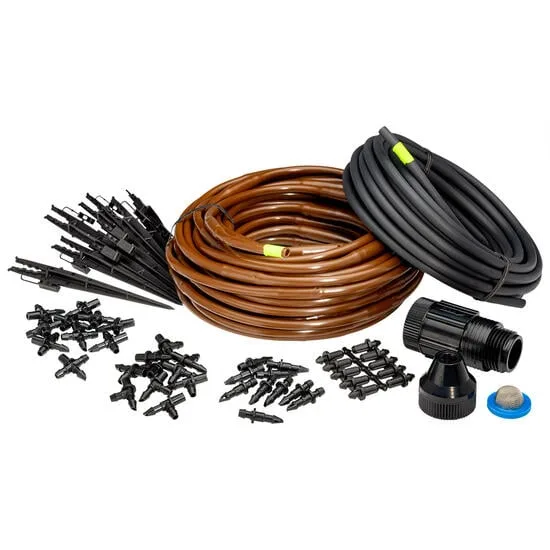
For one conventional raised bed, start with the Rain Bird Raised Bed Garden Kit. Its locked product record is built around a 4-by-8-foot bed and includes 35 feet of 1/4-inch emitter tubing, 25 feet of distribution tubing, a 25 PSI regulator, and a 150-mesh filter. DIG ML50 is the stronger choice when you want five 10-foot lines, emitters every 9 inches, and a stated route to larger layouts.
Raised-bed irrigation is a layout problem as much as a watering problem. The best kit puts emitters where the roots are and gives you enough supply tubing to reach the bed. A kit that works for a neat rectangle may be frustrating around several small beds.
She Gardens used the locked manufacturer pages and the independent drip-irrigation comparison in the research record. She Gardens did not test these kits. Treat the published coverage and flow figures as manufacturer claims, confirm the current model before ordering, and check your faucet, timer, and local water rules yourself.
Raised-bed drip kit comparison
| Product | Best fit | Useful evidence | Main drawback |
|---|---|---|---|
| Rain Bird Raised Bed Garden Kit | One 4-by-8-foot bed | 35 ft emitter tubing; 25 PSI regulator; 150-mesh filter | Less flexible for irregular beds |
| DIG ML50 Raised Bed Drip Irrigation Kit | Expandable bed layout | Five 10 ft lines; 9-inch spacing; up to 150 sq ft | Starting layout is not for a large garden |
| DIG ST100AS Drip Soak Tape Vegetable Watering Kit | Straight rows | 100 ft tape; 12-inch spacing; five connectors | Awkward around irregular plantings |
| DIG GRWKIT-12 Home Grow Drip Kit | Small protected bed | Home-grow kit for small protected or container gardens | Capacity is not stated |
| DIG GE200 Drip and Micro Sprinkler Kit | Multiple beds | Up to 700 sq ft; 200 ft supply tubing; 20 emitters | More parts and layout work |
| DIG GF100 Gravity Feed Drip Kit | Rain-barrel watering | 100 ft drip tubing; 50 button drippers; 155-mesh filter | Needs an elevated reservoir |
| DIG SM50 Adjustable Micro Sprayer Kit | Small irregular bed | Adjustable spray for beds and greenhouse benches | May wet foliage more than dripline |
Best for one standard bed: Rain Bird
Rain Bird is the cleanest match for a 4-by-8-foot raised bed. The manufacturer page lists 35 feet of 1/4-inch emitter tubing with 6-inch spacing, 25 feet of distribution tubing, a 25 PSI regulator, a 150-mesh filter, stakes, and fittings.
The fixed bed format is the catch. A U-shaped bed may need extra tubing or a different kit. Use the dimensions as a fit check.
Pros: Clear 4-by-8-foot layout; 6-inch emitter spacing; regulator and filter included; stakes and fittings included.
Cons: Less adaptable for irregular beds; exact warranty and retailer stock are not stated; timer is an added part.
Check the current Rain Bird kit listing
Best for expansion: DIG ML50
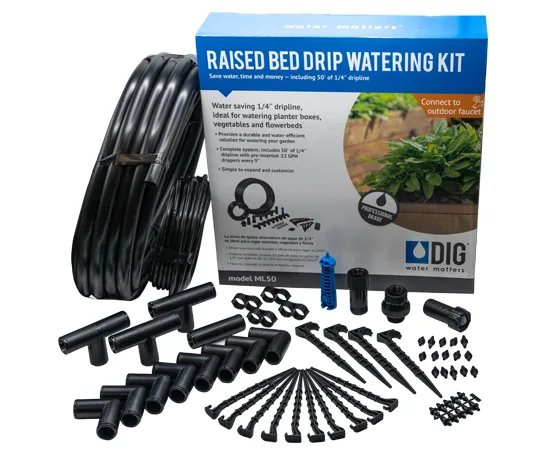
DIG ML50 gives the buyer more control over bed rows. Its manufacturer record lists 50 feet of 1/4-inch dripline, emitters every 9 inches, and up to five 10-foot lines. The kit is listed for up to 150 square feet, with expansion beyond 700 square feet. Flow is listed as 0.52 GPH at 15 PSI or 0.65 GPH at 25 PSI.
The included 25 PSI regulator, filter, backflow preventer, and 1/2-inch supply tubing support a faucet-fed layout. ML50 is still a starting kit, not a whole large-garden plan.
Pros: Five 10-foot lines; 9-inch emitter spacing; documented flow figures; expansion path; pressure parts included.
Cons: Initial coverage is listed at 150 square feet; line layout takes more planning than Rain Bird; exact warranty is not stated.
Check the current DIG ML50 listing
Best for straight vegetable rows: DIG ST100AS
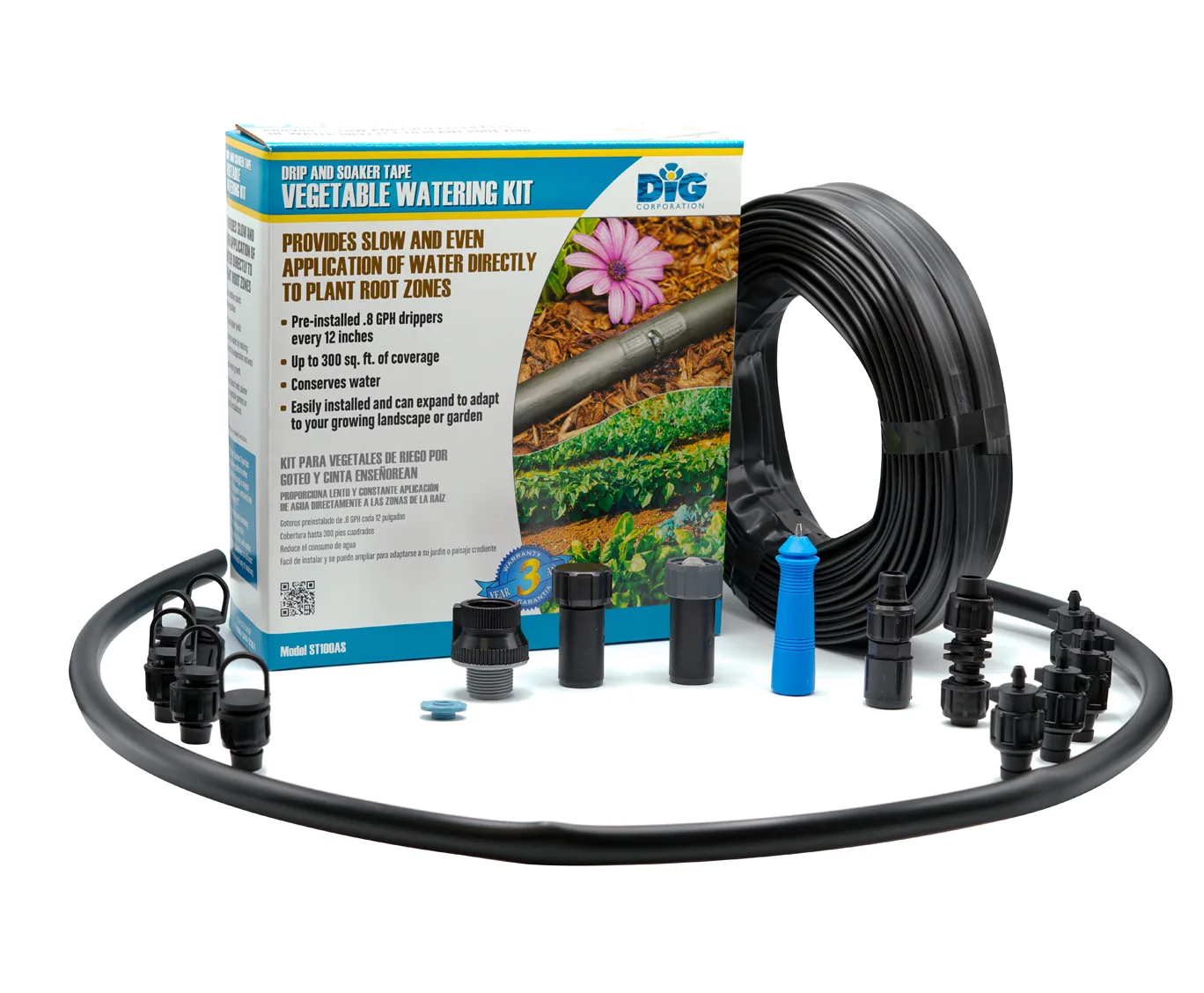
ST100AS is made for rows rather than a collection of scattered plants. DIG lists 100 feet of drip tape, 0.5 GPH emitters every 12 inches at 25 PSI, five rows, flow control, and five connectors on the product page.
That spacing suits a bed planted in straight lines. It is less convenient when plants sit at irregular distances. Plan each row and connector before laying the tape.
Pros: 100-foot tape; five-row setup; 12-inch spacing; documented 25 PSI flow; connectors and flow control included.
Cons: Less useful around irregular beds; not a tree or container layout; exact coverage beyond the row description is not stated.
Check the current DIG ST100AS listing
Other raised-bed options
DIG GRWKIT-12
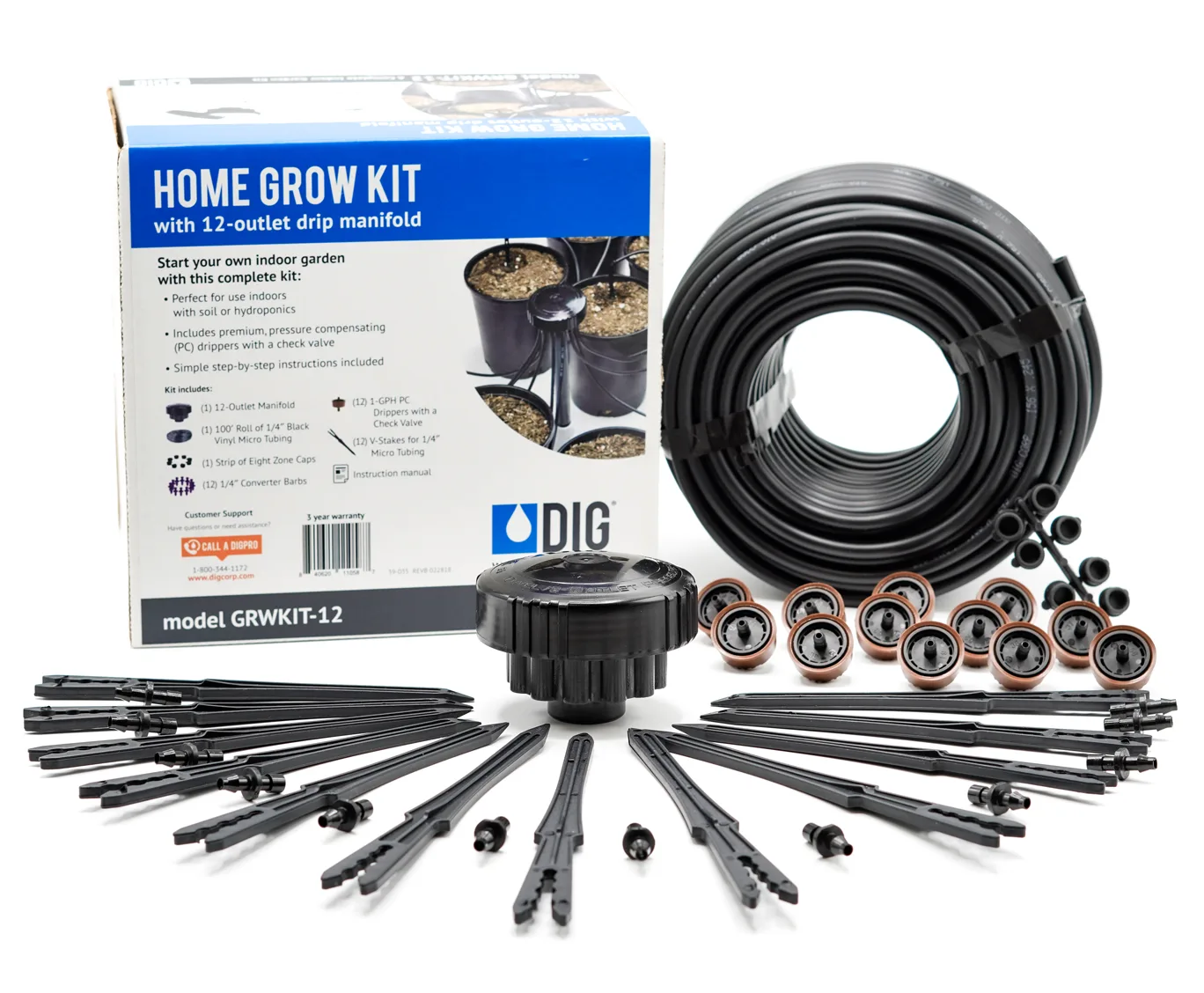
The GRWKIT-12 is aimed at small protected or container gardens. It may suit a raised bed inside a greenhouse, but DIG does not state tubing length, emitter count, or coverage in the locked record.
Pros: Grow-area focus; suitable for small protected gardens; compact starting point.
Cons: Tubing, emitter count, and coverage are not stated; needs a pressurized faucet; less documented capacity than larger kits.
Check the current DIG GRWKIT-12 listing
DIG GE200
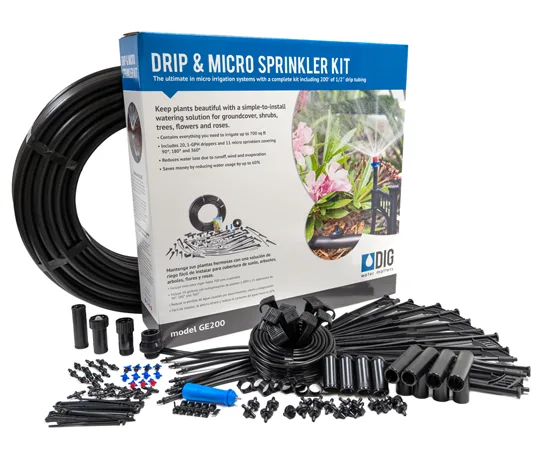
GE200 is the large mixed kit in this group. The manufacturer page lists coverage up to 700 square feet, expansion beyond 1,000 square feet, 200 feet of 1/2-inch tubing, 50 feet of 1/4-inch microtube, 11 micro-sprayers, 20 1-GPH emitters, and a 25 PSI regulator with a backflow preventer.
Use those parts when raised beds sit alongside landscape pockets and need different watering patterns. The tradeoff is a longer setup. Adjustable 360, 180, and 90 degree sprayers add options, but they also add decisions.
Pros: Largest documented capacity here; 200-foot supply tubing; emitters and sprayers; expansion beyond 1,000 square feet.
Cons: More parts to place; spray can suit some plants better than others; needs the faucet flow to support the layout.
Check the current DIG GE200 listing
DIG GF100
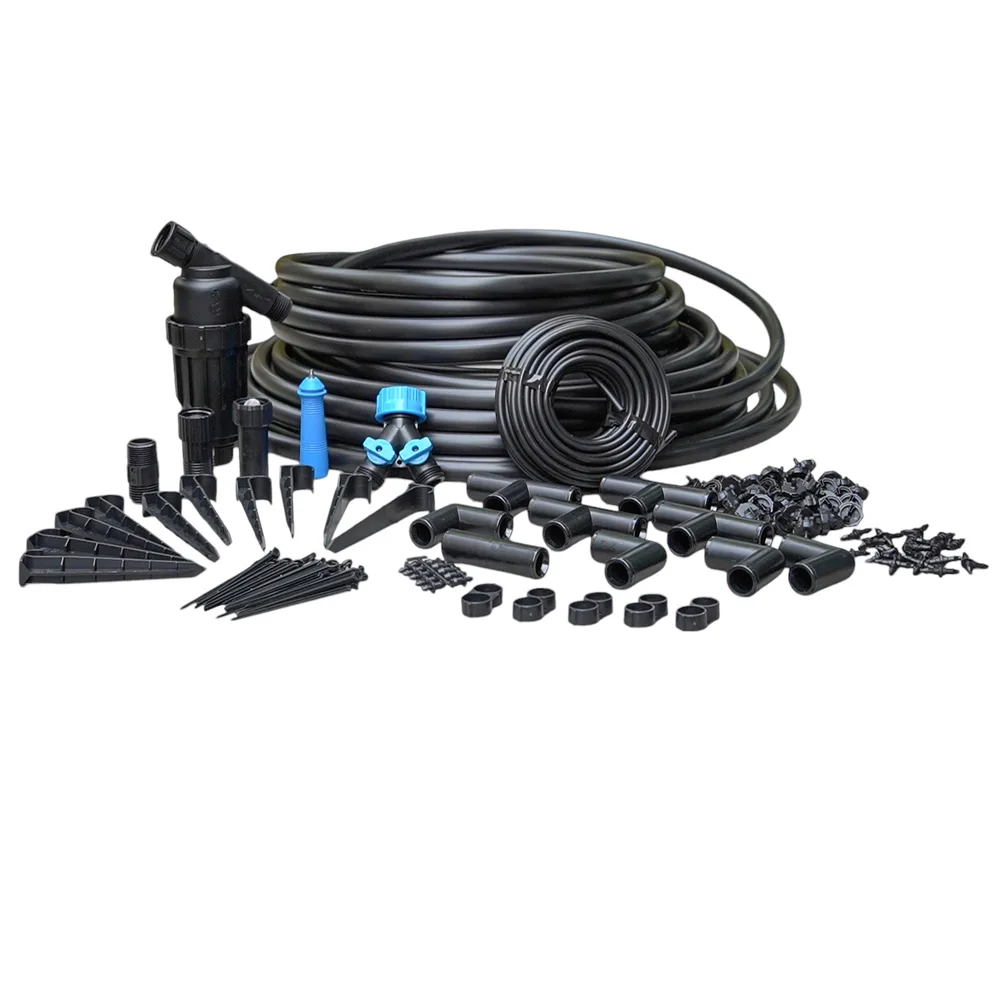
GF100 belongs on a raised bed when the water source is an elevated rain barrel rather than a pressurized faucet. DIG lists 100 feet of 1/2-inch drip tubing, 50 feet of 1/4-inch microtube, 50 button drippers, and a 155-mesh filter on its gravity-feed page.
The reservoir must be elevated enough for the layout. The locked record does not give an automatic controller, so do not assume this kit schedules watering by itself. It is a practical source match, not a universal replacement for a faucet-fed kit.
Pros: Works with an elevated rain barrel; 100-foot drip tubing; 50 drippers; filter included.
Cons: Depends on reservoir elevation; no documented automatic controller; low-pressure layouts need careful checking.
Check the current DIG GF100 listing
DIG SM50
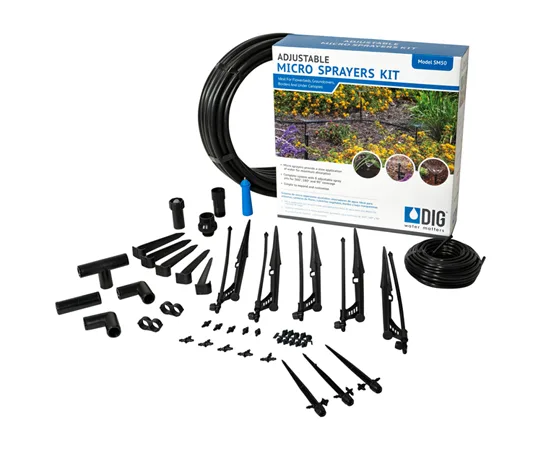
SM50 is the odd one out for a bed that needs adjustable spray instead of point emitters. DIG lists it for small beds, greenhouse benches, and landscape pockets on the product page. The accessible record does not state coverage or included-part count.
Choose it when one adjustable pattern fits an irregular pocket. Drip emitters are easier to keep at individual plant roots, while spray may wet foliage and lose more water in moving air.
Pros: Adjustable pattern; suited to small beds and benches; useful where point emitters do not fit.
Cons: Coverage is not stated; may wet foliage; spray is a poorer fit for a root-by-root layout.
Check the current DIG SM50 listing
How to choose for a raised bed
Measure the bed before choosing the kit. Record its length, width, and distance from the faucet. Rain Bird fits a 4-by-8-foot rectangle. ML50 suits several lines inside a defined area. GE200 fits a larger layout.
Choose dripline or tape for plants arranged in rows. Point emitters and microtube work better when spacing changes from plant to plant. Sprayers cover a patch, but they also put water above the soil. That can be useful in a greenhouse bench and less useful in a dry, windy bed.
Match the kit’s pressure parts to the source, then check whether your faucet supplies enough flow. A timer can automate Rain Bird’s kit, but its 1ZEHTMR is an added compatible part.
For a narrow bed, the small-space hose guide can help with the supply line. For a larger layout, compare the large-garden irrigation guide after release.
Frequently asked questions
What is the best drip irrigation kit for one raised bed?
Rain Bird is the clearest fit for one standard 4-by-8-foot bed because its listed layout, tubing, regulator, filter, stakes, and fittings match that use. DIG ML50 is better when you want five 10-foot lines and an expansion path.
Do raised beds need a pressure regulator?
The kits in this comparison that list a regulator include one because their drip parts are specified around controlled pressure. Follow the product instructions and confirm your source pressure before connecting the system.
Is drip tape or emitter tubing better for raised beds?
Use drip tape when the plants run in straight, repeated rows. Use emitter tubing or point emitters when plant spacing changes. ST100AS is row-focused, while ML50 and the Rain Bird kit are easier to adapt within a bed layout.
Can a rain barrel run raised-bed drip irrigation?
DIG GF100 is the source-matched option here. It is designed for an elevated rain barrel or another low-pressure source. Reservoir height affects the layout, and the locked record does not document an automatic controller.
Recommendation
Choose Rain Bird for one neat 4-by-8-foot bed. Choose DIG ML50 for a bed that may grow. Use ST100AS for straight rows, GE200 for several beds, and GF100 for an elevated rain barrel.
Sources and methodology
Product facts came from the locked Rain Bird and DIG records, with model pages for ML50, ST100AS, GE200, GF100, GRWKIT-12, and SM50. Bob Vila’s comparison supplied independent selection context. She Gardens did not test these products. The ranking follows the locked irrigation manifest dated 29 August 2026.