
Buying guide
Best solar spotlights for your garden: 7 adjustable picks
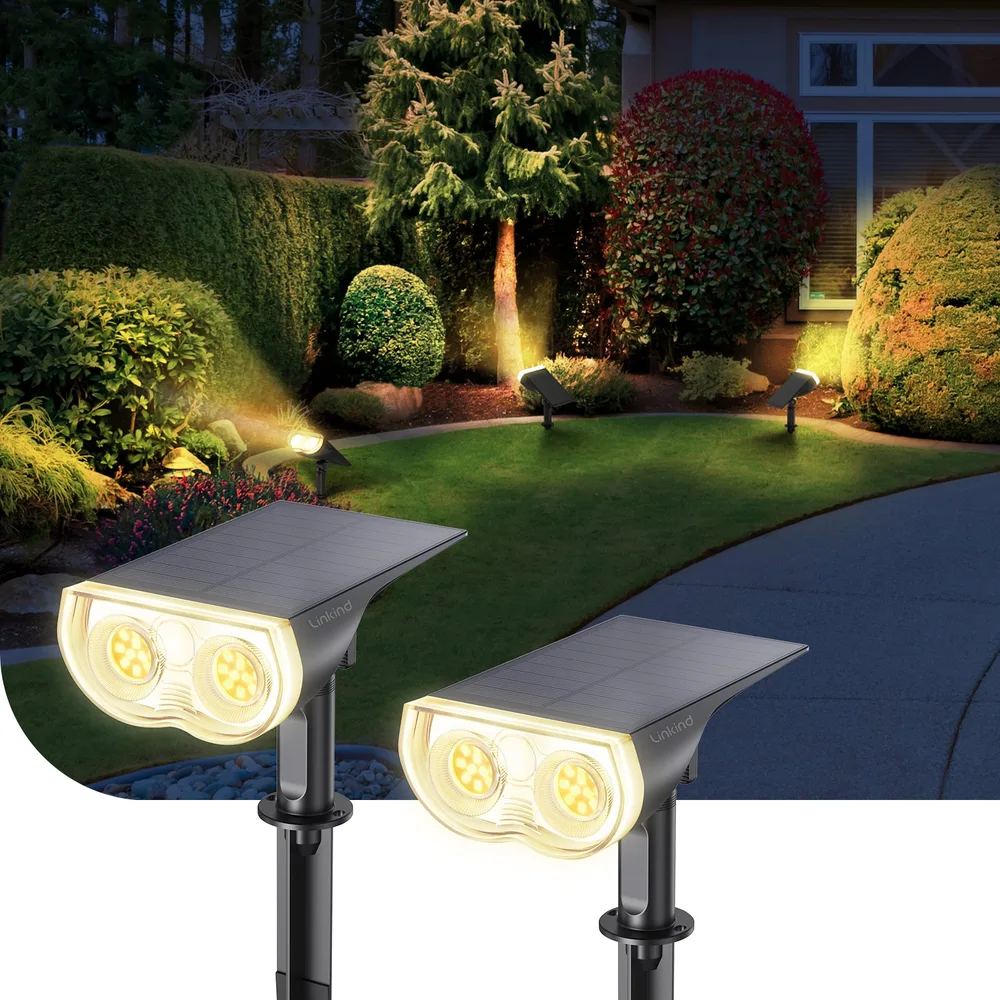
Linkind's StarRay SP001U is the best place to start for most garden features because it combines 650 lm with an adjustable head, adjustable panel, and ground or wall mounting. Its runtime and weather rating still depend on the manufacturer's stated conditions.
Quick answer
The Linkind StarRay Solar Spotlight SP001U is the strongest all-around candidate here. Linkind lists 650 lm, an adjustable head, a panel with 90 degrees of vertical and 180 degrees of horizontal adjustment, and three stated settings: 24 hours on low, 12 hours on medium, and 6 hours on high. It can be staked into the ground or mounted on a wall.
These lights aim at garden features and can mount on stakes or walls. She Gardens did not test these products, measure beam reach, or verify night-by-night runtime. Product facts come from manufacturer documentation. Check the current model, pack, retailer stock, and manual before buying.
| Rank | Product | Best fit | Main drawback |
|---|---|---|---|
| 1 | Linkind StarRay Solar Spotlight SP001U | Bright, adjustable feature lighting | Battery capacity is not disclosed |
| 2 | Linkind Color-Changing Solar Spotlight SP004 | High output with color modes | Runtime is not disclosed |
| 3 | Linkind StarRayS Solar Spotlight SP002 | Aimable spot in wet locations | Lower output than the first two |
| 4 | Linkind Smart Solar Spotlight SL5C | App control and stated runtime | 150 lm output |
| 5 | Linkind Smart Solar Spotlight SL5 | Smart RGB and white control | 150 lm output |
| 6 | Linkind Smart Solar Spotlight SL6C | Ground or wall smart lighting | 200 lm accent-light output |
| 7 | InnoGear MT-035W Warm White Solar Spotlights | Simple warm-white feature lighting | Manufacturer store lists it as sold out |
The seven spotlight picks
1. Linkind StarRay SP001U
The Linkind SP001U has the clearest high-output case here. Its 650-lm rating is higher than most lights here, and the manufacturer gives three runtime claims: 24 hours on low, 12 hours on medium, and 6 hours on high. The head adjusts toward the feature, while the solar panel moves 90 degrees vertically and 180 degrees horizontally.
Ground-stake and wall-mount placement let you aim at a tree, trellis, or wall. Linkind records IP65 and calls the unit drizzle-proof. That wording does not establish submersion tolerance or make a general waterproof promise. Battery chemistry and capacity are not listed on the reviewed page.
Check the Linkind StarRay SP001U
Pros: High documented output, flexible aiming, and two mounting methods. Cons: Battery details are missing, and the high-setting runtime is 6 hours under the stated claim.
2. Linkind Color-Changing SP004
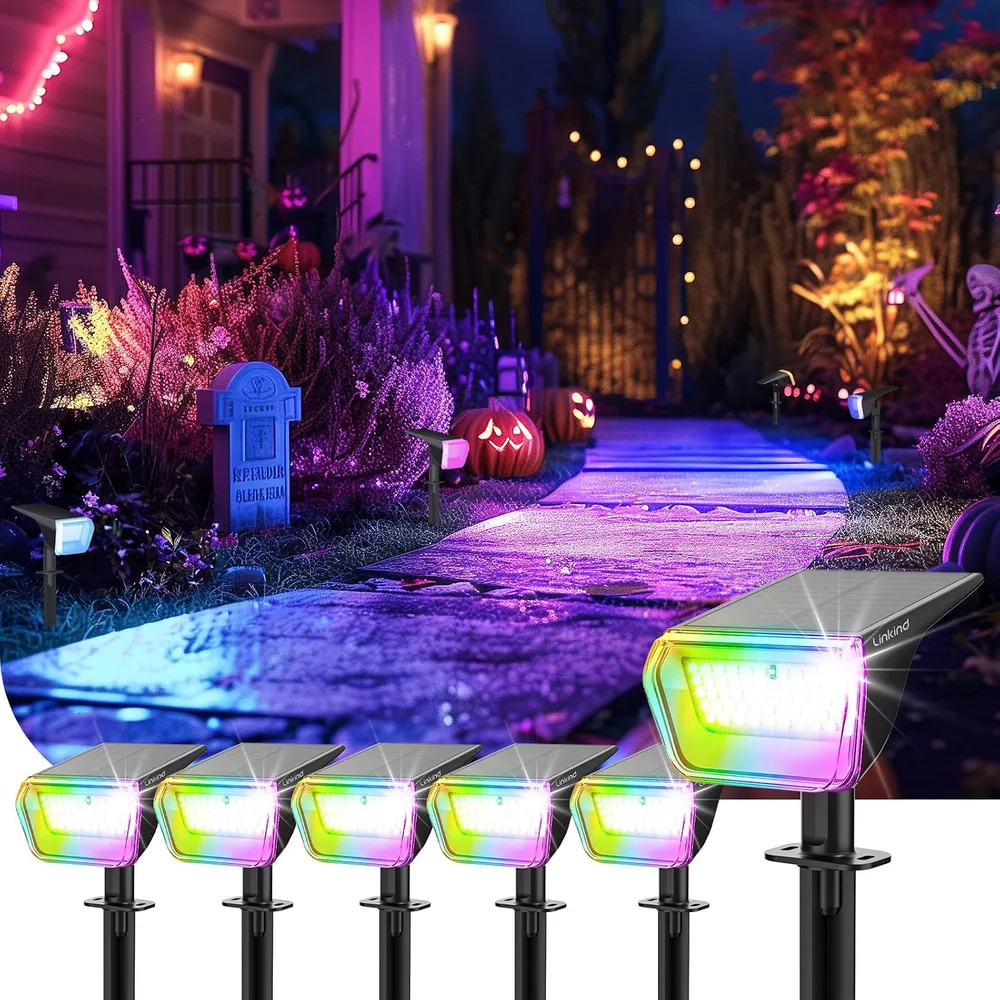
The Linkind SP004 has the highest stated output in the pool at 800 lm. Its 110-degree beam and ground or wall mounting suit a tree, facade, or garden feature. RGB and white modes give you a choice between color accent and conventional light.
The reviewed page does not disclose runtime or battery capacity. It lists a 3.7 V / 1.2 W solar system and IP67 with short-term submersion wording. Brightness alone cannot tell you how long it will stay on.
Pros: Highest documented lumens, a 110-degree beam, and RGB or white modes. Cons: Runtime and battery details are not disclosed.
3. Linkind StarRayS SP002
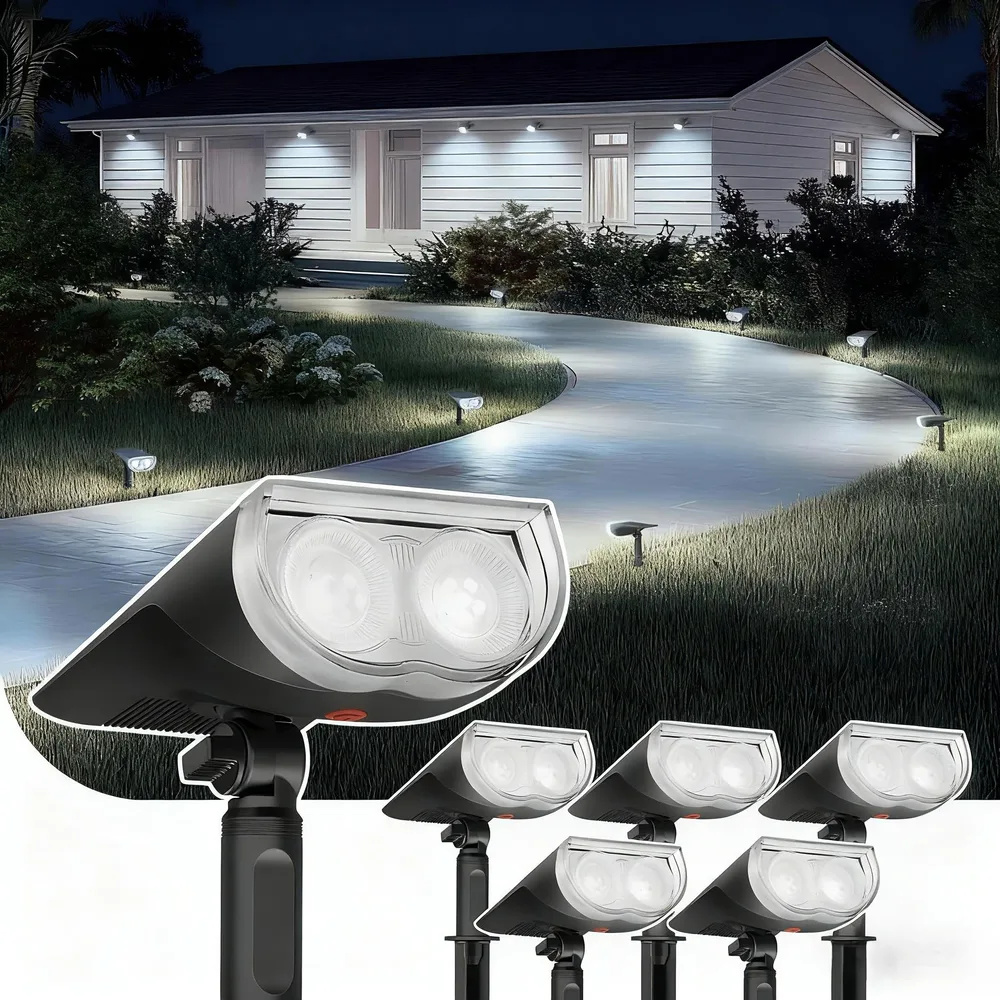
The Linkind SP002 gives you a mid-output spotlight with a two-way adjustable panel and head. Linkind lists 350 lm, up to 12 hours on low, and up to 6 hours on high. It uses a ground stake or wall mount, so you can move the light from feature lighting to a wall when the layout changes.
Linkind’s comparison table and FAQ list IP67, while the page title and feature list say IP65. Confirm the rating on the exact pack and manual. The product should not be used as an underwater light. Battery chemistry and capacity are undisclosed. Choose SP002 for a smaller feature that needs less output than SP001U.
Check the Linkind StarRayS SP002
Pros: Adjustable ground or wall spot, a stated 350 lm rating, and two brightness modes. Cons: Lower output, conflicting weather specifications, and limited battery disclosure.
4. Linkind Smart Solar Spotlight SL5C
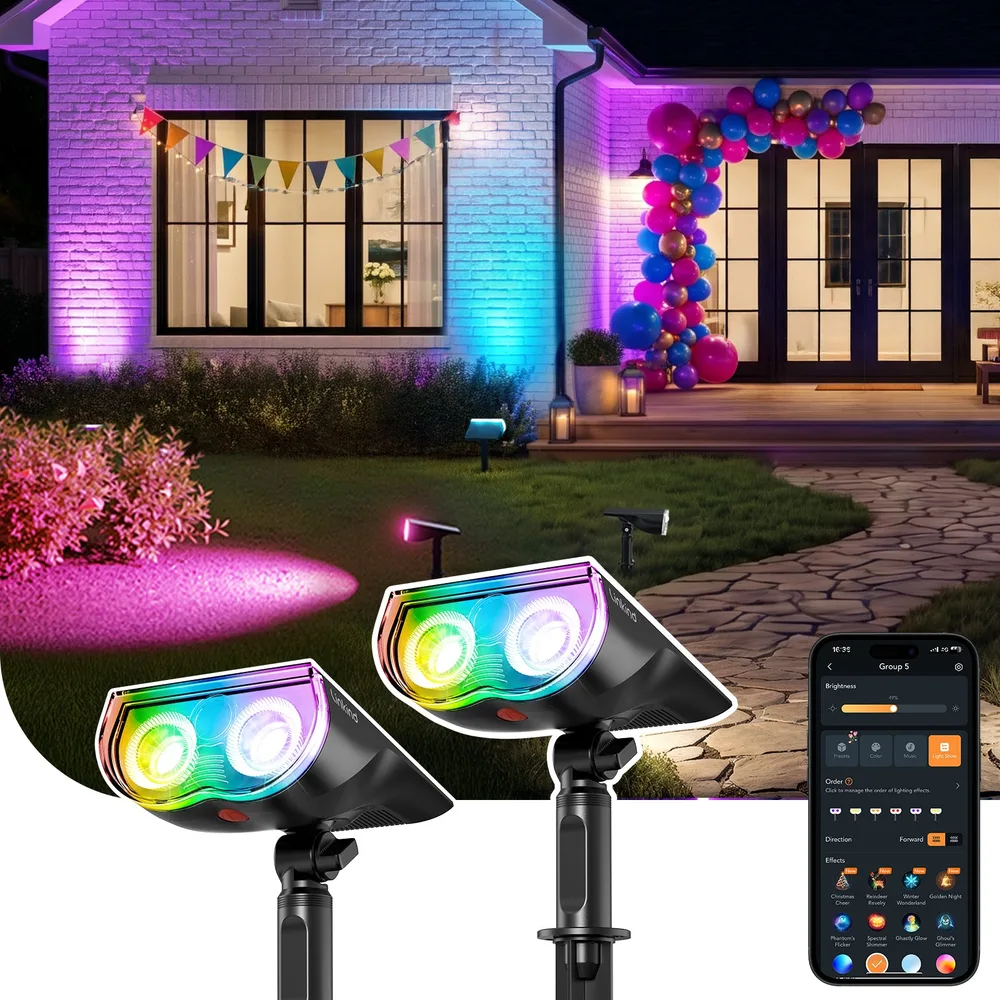
The Linkind SL5C trades output for controls. It is rated at 150 lm, has app and voice controls, and uses a 3.7 V / 1.55 W solar system with MPPT. The manufacturer states up to 14 hours of runtime. Ground-stake and wall-mount placement give it the same basic aiming flexibility as the larger Linkind spots.
The IP67 rating is the documented ingress detail, and Linkind describes short-term submersion. Temperature limits, battery chemistry, and capacity are not stated. At 150 lm, SL5C fits a small accent better than a broad tree wash.
Pros: App and voice controls, MPPT solar system, and a stated runtime. Cons: Much lower output than the dedicated bright spots.
5. Linkind Smart Solar Spotlight SL5
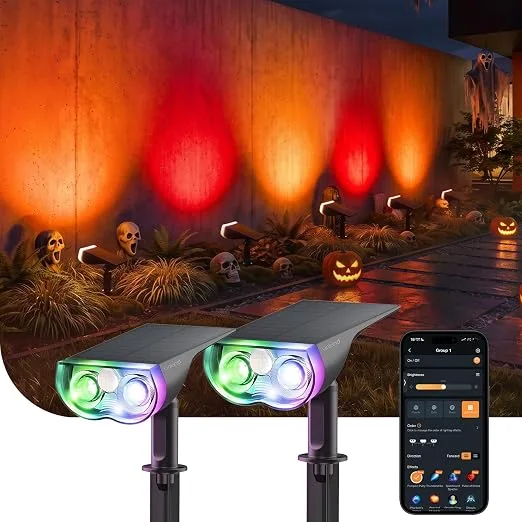
The Linkind SL5 is another 150-lm smart spotlight. The manufacturer lists RGB and tunable-white control, app and voice control, a 3.7 V / 3 W solar system, and ground-stake or wall-mount placement. This is the model to consider when changing color and white tone matters more than a bright beam.
Linkind now lists up to 12 hours with Energy Saving Mode off and up to 14 hours with it enabled. Actual runtime depends on charging and brightness; battery chemistry and capacity are not recorded. The manufacturer lists IP67 and short-term submersion wording. Keep the light’s role to accent work until you know the exact listing and the brightness you need.
Pros: RGB and tunable-white control, app support, and two mounting options. Cons: Low output for a spotlight; runtime changes with brightness and mode.
6. Linkind Smart Solar Spotlight SL6C
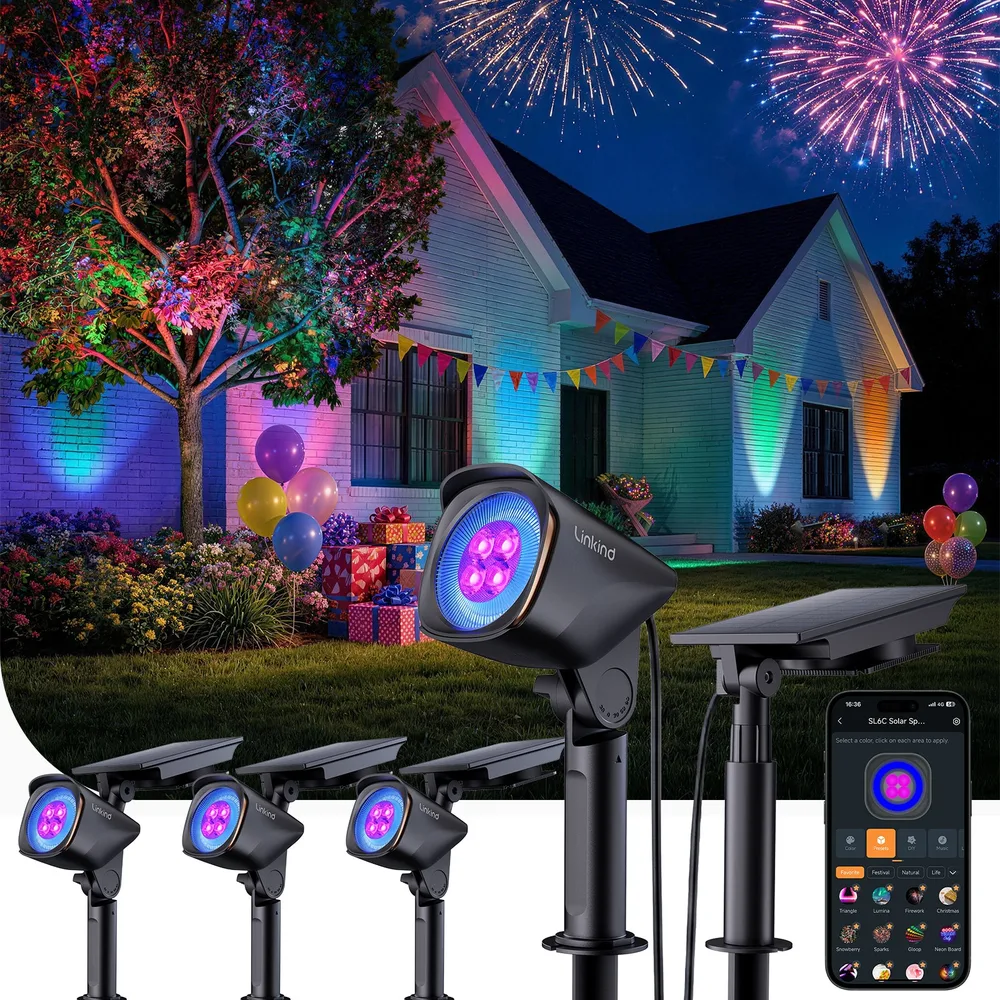
The Linkind SL6C is a 200-lm wall-and-spot model with app and voice controls. It can use a ground stake or wall mount, and it adds USB charging to its 3.7 V / 2 W solar system. Those options help if a wall receives less useful daylight than an open stake location.
The manufacturer lists IP66 and retains the manufacturer’s “storm-proof” wording as a source note. Linkind now cites up to 12 hours of endurance from its manual. Battery capacity is not disclosed. This model fits a smart accent setup where ground and wall placement are useful.
Pros: Wall or ground placement, USB charging, and smart color control. Cons: Lower output than the bright spotlights; battery capacity is not disclosed.
7. InnoGear MT-035W
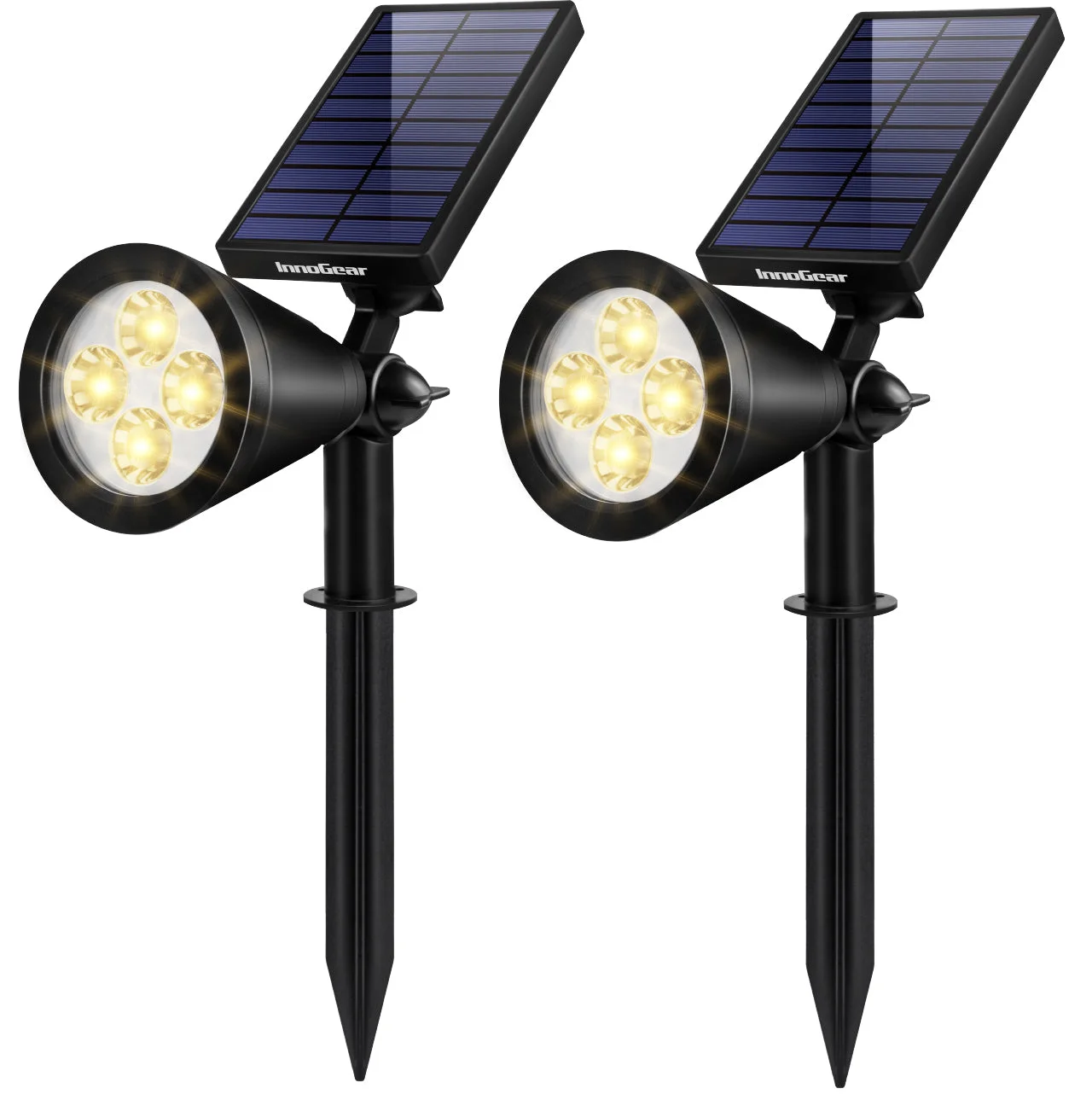
The InnoGear MT-035W is a simpler warm-white option for a small garden feature. Its head and panel adjust independently, and the supplied stakes and screws support ground or wall mounting. It needs no app.
InnoGear lists up to 6 hours on high and 8 to 12 hours on low after charging in sunny conditions. Its own store lists this two-pack as sold out. The manufacturer links to Amazon, but check the exact pack and delivery availability before buying. The page describes water resistance without giving an IP code.
Check the InnoGear MT-035W two-pack
Pros: Separate head and panel adjustment, two mounting options, and simple brightness controls. Cons: Stock needs checking, and the source gives no IP code.
For path markers or decorative bulbs, see the mixed solar garden-light guide.
What to check before choosing a garden spotlight
Pick the target first. A spotlight should aim at a feature, so head adjustment and panel angle matter. SP001U and SP002 document both. SP004 documents a 110-degree beam. The smart models give control and flexible mounting, but their 150 to 200 lm ratings suit smaller accents better than the top two spots.
Put the panel where it can charge. A light aimed at a tree may need its panel tilted away from the tree’s shade. The manufacturer pages do not promise a fixed runtime in shade. Govee’s separate string record ties its runtime to brightness and sun exposure. The garden hose guide for small spaces covers a different placement problem, but the same practical question applies: check the actual space before choosing the product. For colder storage conditions, see the cold-weather hose guide.
Treat lumens and runtime as separate fields. A higher lumen rating can mean more output, while a runtime claim describes a particular setting or condition. SP001U’s high setting is listed at 6 hours. SL5C’s up-to-14-hour claim does not tell you the brightness setting in the same way. Do not combine the numbers into a prediction for your garden.
Weather labels need their exact wording. IP65, IP66, and IP67 are ingress ratings. Drizzle-proof, splash-proof, storm-proof, and short-term submersion remain narrower than a waterproof claim. Check the manual for mounting and charging instructions.
Frequently asked questions
Which solar spotlight is brightest for a garden?
Linkind SP004 has the highest documented output at 800 lm. SP001U ranks first overall because it combines a high 650-lm rating with more complete aiming and runtime information.
How long do solar spotlights stay on?
It depends on the model, setting, sunlight, and battery condition. The manufacturer pages state 6 to 24 hours for SP001U, 6 to 12 hours for SP002, and up to 14 hours for SL5C. These are manufacturer claims.
Can a solar spotlight go on a wall?
SP001U, SP002, SP004, SL5C, SL5, and SL6C document ground-stake or wall-mount placement. Use the exact current instructions for the fasteners and panel position.
Is an IP67 solar spotlight waterproof?
IP67 is an ingress rating. SP002 and SP004 also have manufacturer short-term submersion wording, but the reviewed pages do not define every duration or condition. Do not turn that into a blanket waterproof promise.
Recommendation
Choose SP001U for the best mix of documented brightness, aiming, and runtime. Choose SP004 when 800 lm and color modes matter more than a stated runtime. SP002 is the mid-output option, while SL5C is the smart pick with a documented up-to-14-hour claim. Choose InnoGear MT-035W for simple warm-white lighting if the two-pack is available.
Sources and methodology
She Gardens used the solar-light shortlist researched on 29 August 2026, with manufacturer-page checks and the InnoGear addition on 12 October 2026. Product facts came from Linkind SP001U, SP004, SP002, SL5C, SL5, SL6C, and InnoGear MT-035W. Category context came from Tom’s Guide and HGTV. She Gardens did not test these lights or verify current stock and pack variants.